viernes, 7 de septiembre de 2012

20 pilot whales came ashore


ST. LUCIE COUNTY — Hundreds of Treasure Coast residents converged on Avalon Beach State Park Saturday in what became an all-day struggle to rescue a pod of short-fin pilot whales that stranded themselves in the surf.
Twenty-two of the sleek, black marine mammals, ranging in size from 5-foot juveniles to 18-foot adults weighing around one ton, languished in the sun. Volunteers under the direction of biologists and veterinarians wrestled the whales upright to help them breath, covered their skins with moist towels and poured water over them.
The animals came ashore sometime before 9 a.m. One of the first on scene was Blair Mase, stranding coordinator for the Southeast Region with the National Oceanographic and Atmospheric Administration. By coincidence, Mase, who recently moved to Vero Beach, was surfing in the area when she noticed people running toward the whales.
Mase said in such instances, it is useless to simply push pilot whales back into the ocean.
"This species has a tight social structure," Mase said. "Typically, they stay together as a group. So if one animal is sick, they all come ashore. If you push them into the water, they'll just keep coming back and stranding themselves again."
Scientists are not certain why pilot whales deliberately swim up onto beaches, although Mase said it is the species that most often does in Florida.
It may be a hard-wired instinct to follow their leader, said Steve McCulloch, manager of the Marine Mammal Stranding Network for Harbor Branch Oceanographic Institute at Florida Atlantic University. Pilot whales are highly social animals and appear to take direction from one alpha individual. If that whale gets sick and beaches itself, the rest seem to follow without realizing that it's going to kill them, he added.
There were five calves in the stranded pod and McCulloch said they have the best chances of being saved. They were taken to Harbor Branch Saturday afternoon to be medically evaluated and rehydrated.
"Sadly, without the facilities and resources that are critically needed, the rest probably cannot be saved," he said. "The other whales will be humanely euthanized."
By noon, scientists were busy triaging the whales to determine which could be saved. Harbor Branch veterinarian Kattis Stengard took blood samples from the dorsal fins of each whale, which was then measured and tagged. Scientists intend to perform necropsies in an effort to learn more about the deep-water creatures.
McCulloch said mass strandings are rare and attract a lot of public attention.
"But for scientists, they are a treasure trove of information," he added.
Two large adult whales had died by early afternoon.
Hubbs-Sea World Research Institute and the Florida Fish and Wildlife Conservation Commission also were part of the team effort.
Volunteers from Pelican Island Audubon Society, Harbor Branch, surfers and passers-by worked in the blazing midday sun, kneeling in the sand to tend the whales.
More volunteers from the North Treasure Coast Chapter of the American Red Cross passed drinks and snacks. They also raised tents on the beach to shade both beasts and people — some of whom performed as human buttresses, bracing the bigger whales with their backs to keep them from rolling over and suffocating because their weight was not buoyed by water.
The sad undercurrent running through Saturday's crowd was the knowledge that most of the animals were dying.
"We have had volunteers out here since this morning, pouring their hearts and souls out," Mase said. "These people are trying to save these whales and, for those that cannot be saved, trying to make their last hours more comfortable."
Jacqui Thurlow-Lippisth, a Harbor Branch volunteer, was working with others at a shaded inflatable pool, tending the juveniles that veterinarians hoped to rehabilitate.
"I think that people want to help animals," she said. "Especially whales and dolphins, because they are our counterparts in the seas. They're mammals, they're intelligent, they're social. They're a lot like us."
Mase said she's been working whale strandings for 20 years and sees this type of humane outpouring all the time.
"It pulls at their heartstrings," she said. "Saving whales is a human thing."

miércoles, 5 de septiembre de 2012

New Seahorse

Boston, MA — A new underwater explorer hit the seas this summer, armed with cameras, strobes and sonar and charged with being a protector of sorts to a half-billion dollar resource — the Atlantic scallop catch.

The stainless steel Seahorse, which gets its nickname from its s-shaped silhouette, traces its roots to a conversation a decade ago between a biologist and a fisherman who was seeking a better way to track the scallop population.


This summer, the instrument was towed over miles of seafloor, from Virginia to Cape Cod, taking millions of images and capturing details about marine life and the ocean floor that stretched beyond just the number of scallops.


The Seahorse revealed previously unseen ocean topography, predators stalking prey, and even the furrows left where fishing gear was pulled along the bottom.


Marine scientists just don't get this kind of look into the darkness on the ocean floor, said Dvora Hart, a National Oceanic and Atmospheric Administration mathematical biologist who leads the federal sea scallop assessment.


"We've been kind of blind before having this type of information," Hart said.


The Seahorse is the fourth version of HabCam, an instrument originally created to better count scallops. Former scalloper Richard Taylor had seen scallop industry's worst times around 1994, when the prime fishing areas were closed to protect depleted groundfish and scallop populations.


But by 1996, scientists discovered that areas that had been shut down to protect certain fish species were rich with scallops. The industry has been thriving since the late 1990s, after regulators installed a plan to cut down fishing days and rotate fishing between different areas, to allow the stock to replenish in untouched regions.


Last year, the Atlantic sea scallop catch was worth $580 million in revenues, and the industry's best-known port of New Bedford has been the nation's top fishing revenue port for 11 years running.


Back around 2002, Taylor knew things were going well, but also knew how quickly they can go bad. He was particularly concerned about the inefficiency of the primary method for sampling scallops for use in population estimates — using a dredge to scoop them up. A dredge misses varying percentages of the scallops it goes over, and Taylor worried the flawed information could eventually lead to the overfishing or underfishing that can drag down the resource and the fishermen.


Taylor talked with Woods Hole Oceanographic Institution biologist Scott Gallager, whom he had worked with on scallop issues. "We need a better tool," he told Gallager.


They helped develop the Seahorse, along with the Deep Submergence Laboratory at Woods Hole. It's an advance over previous versions of HabCam because it's equipped with strobes and two cameras, instead of one, enabling it to take 3-D pictures at a rate of 10 overlapping images per second. It has side sonar to give high resolution images of the surrounding topography, and also equipment to measure variables such as temperature and water color.


The Seahorse is towed at about 7 mph, and moves 6 feet above the ocean floor. The instrument, about 10 feet long and about 3 feet wide, is controlled by joystick by an operator in the towing vessel.


Since 2010, NOAA has spent $856,000 to develop, test and deploy the Seahorse.


Researchers have made a first pass through the 7 million images, studying 1 of every 200, and the data is being used in management decisions, Hart said. A more detailed look is planned, she said.


The voluminous detail the Seahorse collects has application well beyond scallops and their habitat. Hart notes, for instance, that the Seahorse captured pictures of the struggling yellowtail flounder, and may contribute to research in that fishery. Its images of the effects of fishing gear can inform the hot, yet data-poor debate about whether fishing gear is wrecking the ocean bottom.


The Seahorse can't replace the dredge as a sampling tool. Scientists need to actually pull up scallops to get key information, such as by studying rings on the shells (much like tree rings) to learn about their growth rates.


And Taylor cautioned that new data from the Seahorse doesn't necessarily mean much when it comes to managing fisheries.


"I'm somewhat skeptical," he said. "Just because you have better data, doesn't mean automatically that better decisions are made."


Scalloper Paul Rosonina runs a vessel that's towed the Seahorse and has been part of its development for years. Scallop industry regulators can't do the right thing without good information, and that's what the Seahorse is about to him.


"You think I don't want my son to have a future?" he said. "I want my grandson to have a future; I want my great grandson to have a future. I don't want this to die. ... I think it should be around forever."

lunes, 3 de septiembre de 2012

Great White Shark Washer ashore

Boston, MA - A massive shark washed up on a New England beach this weekend, prompting officials to close down two nearby beaches.
The Great White weighing about 1,600 pounds was discovered on the border of Rhode Island and Massachusetts.

When fisherman Gary Severa first spotted the 13-foot predator Saturday morning, he thought it was driftwood but after getting a closer look there was no mistaking what he found.

"It was pretty scary standing next to that thing…it made your adrenaline go cause he's stone dead, but my God, it has jaws written all over it," Severa said.

Officials are not sure why this great white died or how it ended up here. Taking no chances, they closed the two nearby beaches - South Shore Beach and Goosewing Beach- for swimmers.

Officials closed nearly 10 miles of Cape Cod beaches because it was "not safe to go back in the water," after that stretch of Massachusetts sand was the scene of a feeding frenzy caught on tape last month.

A video taken on Aug. 22 shows another great white feasting on a seal just inches from a family's boat, as they looked on in horror.

Last Thursday, seven sharks were spotted off the coast of two other Cape Cod beaches, some just feet from the shore.

"I'm glad summer is over. Don't think I'll go back in the water…," said beach goer Kristin Allder.

Greg Skomal of the Massachusetts Division of Marine Fisheries told ABC News affiliate WCVB that they will conduct test to find out what caused the shark's death.

"We're going to look at the stomach - what it's been eating," Skomal told WCVB.

sábado, 25 de agosto de 2012

Hong Kong Probes Liability for Plastic Pellet Spill

HONG KONG, China, August 14, 2012 (ENS) – Hong Kong Chief Executive Leung Chun-ying says he supports the investigation into who is responsible for the plastic pellet spill, in which around 150 tonnes of plastic were dumped into the sea.

Hong Kong officials have said repeatedly that the plastic pellets pose no immediate threat to food and environmental safety. But environmentalists warn that the pellets, known as nurdles, can absorb pollutants from sea water, thus becoming toxic themselves.

Leung said is concerned about the spill and has maintained close contact with government departments involved in the cleanup.

Chief Secretary Carrie Lam said, “The Department of Justice together with the Marine Department are discussing the matter, tracing the whole incident, and looking at various parties involved.”
Overnight July 23-24 the plastic pellets were being shipped from Guangzhou to Shantou, both in southern China’s Guangdong Province, when the cargo ship Yong Xin Jie 1 ran into Typhoon Vicente, the worst storm to strike Hong Kong in more than a decade.

Seven 40-foot-long containers were lost overboard in the waters south of Hong Kong. 

Six of the containers contained sacks of small plastic pellets used in the manufacture of other plastic products, about 150 tonnes in total, according to Hong Kong environmental authorities. One container held bottles.

Five of the containers full of plastic pellets were located by the Hong Kong Marine Department, which salvaged the containers and the plastic pellets at sea. 

About 50 tonnes of pellets in 25 kg sacks were collected from the water, but many of the sacks that were still adrift broke open, releasing tonnes of the pellets that piled up in great white drifts across 10 Hong Kong beaches or scattered across the sand.

The sixth container known to hold sacks of plastic pellets is still missing.

The Xiamen-registered Yong Xin Jie 1 was leased to shipping agent China Shipping Container Lines at the time of the incident.

On Thursday, petroleum giant Sinopec, the company that produced the plastic pellets, pledged to establish a HK$10 million (US$1.3 million) fund to locate and salvage the missing sixth container and clean up the remaining pellets.

Lu Dapeng, a spokesman for Sinopec, said it was up to judicial and administrative authorities to determine who is responsible for the incident. He urged the shipping agent and carriers to provide incident reports as soon as possible.

Lu said the company was deeply worried over the spill incident which led to environmental impact and caused disturbance and inconvenience for Hong Kong residents. He said the company’s top priority is to find the missing container and halt further pollution.

So far, about 21 tonnes of the plastic pellets washed ashore have been cleared. Together with those collected by the Marine Department at sea, about half of the plastic pellets have been cleared. Some have been landfilled, but some of the pellets will be recycled, according to the Hong Kong Environment Department.

Chief Executive Leung told reporters the pellets must be cleared and attention should be paid to whether fish farm operators need assistance from the city government. Lam said the city government would provide support to those in the mariculture industry affected by the spill.

The Hong Kong government last week said the cleanup could take months. The Marine Department will continue helicopter searches, step up patrols along the coastline and arrange reinforcement from other districts to tackle the incident.

jueves, 23 de agosto de 2012

Endangered brown pelicans on North Deer Island

North Deer is one of the few natural islands left in Galveston Bay, as most natural islands have been lost due to subsidence and erosion. The most productive bird nesting island on the Texas Gulf coast, North Deer Island has experienced up to 10 feet of erosion per year. 

“This island has been extremely important to the recovery of the Brown pelican in Galveston Bay. Based on a strong and healthy population, our agency has proposed removal of the Brown pelican from the endangered species list,” said Benjamin Tuggle, regional director for the U.S. Fish and Wildlife Service. 

The young produced here are likely the birds that everyone sees wading in marshes and bayous throughout the Houston-Galveston area, Tuggle said. 

The erosion-protection project is part of the region’s habitat conservation goals established by the Galveston Bay Estuary Program partnership, whose mission is to preserve the bay’s economic and ecologic health. Partners worked for eight years to restore and protect North Deer Island’s eroding shoreline. 

Erosion destroyed habitat for up to 30,000 nesting pairs of birds that were using the island as well as nursery areas for commercially and recreationally important finfish and shellfish. 

Project partners barged in 24,100 tons of rock from a quarry in Missouri, using the Mississippi River and the Intracoastal Waterway as a route, to create 6,450 feet of stone breakwater and armored shoreline. 

The planning, engineering, and construction costs for the eight year endeavor totaled more than $3.2 million dollars. 

“These group efforts demonstrate that by working together we can turn good ideas into tangible results,” said Jamie Schubert, a biologist and project manager for the Texas Parks and Wildlife Department. 

“These habitats are important to our economy,” said Schubert. “Fish and wildlife resources in Texas contribute over $8 billion to the economy. These resources also are part of our natural heritage and deserve our consideration for their intrinsic value. By protecting the island, we ensure that these benefits will be there for our children.” 

The 144 acre island is co-owned by Houston and Texas Audubon. The island is managed as a bird sanctuary. No trespassing signs are posted and predators are removed. 

The salt marshes on the southeast side of North Deer Island are nurseries for fish and shellfish, and these salt marshes are important foraging sites for birds breeding on the island, according to the Houston Audubon Society. 

All species nesting on North Deer Island are migratory to some degree, and in winter, island marshes are used by migrating waterfowl. 

The partnership includes Audubon Texas, the Houston Audubon Society, EcoNRG, U.S. Environmental Protection Agency Gulf of Mexico Program, the Kempner Foundation, Meadows Foundation, Reliant Energy, Shell Marine, the National Fish and Wildlife Foundation, the Texas Commission on Environmental Quality, the Galveston Bay Estuary Program, the Texas General Land Office,

martes, 21 de agosto de 2012

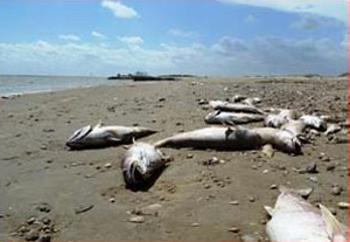
Thousands of Dead Fish Wash Up on Galveston Island

GALVESTON, Texas, August 13, 2012 (ENS) – Thousands of dead fish that washed ashore on Galveston Island over the weekend were killed by a toxic algal bloom, state officials confirmed Monday.
The Texas Department of State Health Services said a bloom of Karenia brevis, also known as red tide, was found in Galveston Bay in concentrations high enough to kill the fish.

Texas Parks and Wildlife Department officials began receiving reports of fish kills on Friday.
The reports were from Quintana Beach to the mouth of the Colorado River and included mostly Gulf menhaden, also called shad, with a few mentions of gafftopsail and hardhead catfish.


dead fish

Additional fish kills were reported over the weekend at Surfside Beach and Galveston; samples were collected from the Surfside jetty and San Luis Pass to look for Karenia brevis. 

In addition, fishermen reported coughing and dead fish 4 miles offshore of Galveston. Dead flounder and stingrays have been reported at Kemah and Bacliff.

Biologists originally thought that low oxygen levels were to blame, so additional investigations were conducted to determine if K. brevis was, in fact, the cause. 

On Sunday, the Texas Health Services biologists found varying levels of K. brevis in their sampling and officials then closed the following several areas of Galveston Bay to shellfish harvesting.
State officials are still investigating this event. Weather permitting, Texas Parks and Wildlife officials intend to conduct a coastal overflight later this week to get an aerial view of the bloom.
In Galveston, Parks Board Executive Director Kelly de Schaun told reporters crews worked overnight to clean the beaches most frequented by the public and the western end of the island, which had the largest concentrations of dead fish. 

A second, smaller wave of dead fish arrived Monday morning and was removed, she said. Crews must clean the entire 32 miles of island beachfront, which is likely to take until Wednesday, de Schaun said.
In 2011 a red tide  covered most of the Texas Gulf Coast and Galveston Bay, closing oyster beds to harvesting.

K. brevis produces a toxin that affects the central nervous system of fish so that they are paralyzed and cannot breathe. As a result, red tide blooms often result in dead fish washing up on Gulf beaches. Three common signs of a red tide bloom are discolored water, dead fish and breathing difficulty, according to state health officials.

Jack Ralph, former head of the Texas Parks and Wildlife Department’s Kills and Spills Team said it may not be necessary to cancel a trip to the Texas Gulf coast just because of a red tide.

“If it were my family heading to the coast, I would not cancel a vacation because of red tide. It’s an isolated, patchy phenomenon that does not blanket every stretch of beach. On any given day, there are generally miles of good beach and clean water for beach-goers and anglers to enjoy. However, we encourage all travelers to heed the advice of the Texas Department of State Health Services, get the current facts and draw their own conclusions, since different people have different comfort levels with these kinds of situations.”
It’s usually okay to eat fish, crabs and shrimp during a red tide bloom because the toxin is not absorbed into the fleshy tissues of these animals, says the Texas state health department which adds that people should never eat fish found sick or dead, whether or not they are caught during a red tide.
Sightings of dead fish or suspected red tide can be reported 24 hours a day to Texas Parks and Wildlife Department officials communication centers; call 512-389-4848 in Austin or 281-842-8100 in La Porte.

lunes, 20 de agosto de 2012

Can help save coral

Southampton, UK — Research from the University of Southampton and the National Oceanography Centre, Southampton has found that an imbalance of nutrients in reef waters can increase the bleaching susceptibility of reef corals.

Corals are made up of many polyps that jointly form a layer of living tissue covering the calcareous skeletons. They depend on single-celled algae called zooxanthellae, which live within the coral polyps.

The coral animal and the associated zooxanthellae depend on each other for survival in a symbiotic relationship, where the coral supplies the algae with nutrients and a place to live. In turn, the algae offer the coral some products of their photosynthesis, providing them with an important energy source.

High water temperatures can block photosynthetic reactions in the algal cells causing a build-up of toxic oxygen compounds, which threaten the coral and can result in a loss of the zooxanthellae.

Without the algae, corals appear white, a state which is often referred to as 'bleached'. Bleaching often leads to coral death and mass coral bleaching has had already devastating effects on coral reef ecosystems.

The study of University of Southampton, published in the latest issue of the journal Nature Climate Change, has found that nutrient enrichment of the water can increase the probability of corals to suffer from heat-induced bleaching.

Within the coral, the growth of zooxanthellae is restricted by the limited supply of nutrients. This allows the algae to transfer a substantial amount of their photosynthetically fixed carbon to the coral, which is crucial for the symbiotic relationship.

Algal growth becomes unbalanced when the availability of a specific nutrient decreases compared to the cellular demand, a condition called nutrient starvation.

Researchers from the University of Southampton based at the Coral Reef Laboratory in the National Oceanography Centre, Southampton, found that an increased supply of dissolved nitrogen compounds in combination with a restricted availability of phosphate results in phosphate starvation of the algae. This condition is associated with a reduction in photosynthetic efficiency and increases the susceptibility of corals to temperature and light-induced bleaching.

Dr Jörg Wiedenmann, Senior Lecturer of Biological Oceanography at the University of Southampton and Head of the Coral Reef Laboratory, who led the study, says: "Our findings suggest that the most severe impact on coral health might actually not arise from the over-enrichment with one group of nutrients, for example, nitrogen, but from the resulting relative depletion of other types such as phosphate that is caused by the increased demand of the growing zooxanthellae populations."

Dr Wiedenmann adds: "Our results have strong implications for coastal management. The findings suggest that a balanced reduction of the nutrient input in coastal waters could help to mitigate the effects of increasing seawater temperatures on coral reefs. However, such measures will be effective only for a short period of time, so it is important to stop the warming of the oceans, which will otherwise destroy most of the reefs in their present form in the near future.

"Finally, our results should help the design of functioning marine reserves.."