sábado, 25 de agosto de 2012

Hong Kong Probes Liability for Plastic Pellet Spill

HONG KONG, China, August 14, 2012 (ENS) – Hong Kong Chief Executive Leung Chun-ying says he supports the investigation into who is responsible for the plastic pellet spill, in which around 150 tonnes of plastic were dumped into the sea.

Hong Kong officials have said repeatedly that the plastic pellets pose no immediate threat to food and environmental safety. But environmentalists warn that the pellets, known as nurdles, can absorb pollutants from sea water, thus becoming toxic themselves.

Leung said is concerned about the spill and has maintained close contact with government departments involved in the cleanup.

Chief Secretary Carrie Lam said, “The Department of Justice together with the Marine Department are discussing the matter, tracing the whole incident, and looking at various parties involved.”
Overnight July 23-24 the plastic pellets were being shipped from Guangzhou to Shantou, both in southern China’s Guangdong Province, when the cargo ship Yong Xin Jie 1 ran into Typhoon Vicente, the worst storm to strike Hong Kong in more than a decade.

Seven 40-foot-long containers were lost overboard in the waters south of Hong Kong. 

Six of the containers contained sacks of small plastic pellets used in the manufacture of other plastic products, about 150 tonnes in total, according to Hong Kong environmental authorities. One container held bottles.

Five of the containers full of plastic pellets were located by the Hong Kong Marine Department, which salvaged the containers and the plastic pellets at sea. 

About 50 tonnes of pellets in 25 kg sacks were collected from the water, but many of the sacks that were still adrift broke open, releasing tonnes of the pellets that piled up in great white drifts across 10 Hong Kong beaches or scattered across the sand.

The sixth container known to hold sacks of plastic pellets is still missing.

The Xiamen-registered Yong Xin Jie 1 was leased to shipping agent China Shipping Container Lines at the time of the incident.

On Thursday, petroleum giant Sinopec, the company that produced the plastic pellets, pledged to establish a HK$10 million (US$1.3 million) fund to locate and salvage the missing sixth container and clean up the remaining pellets.

Lu Dapeng, a spokesman for Sinopec, said it was up to judicial and administrative authorities to determine who is responsible for the incident. He urged the shipping agent and carriers to provide incident reports as soon as possible.

Lu said the company was deeply worried over the spill incident which led to environmental impact and caused disturbance and inconvenience for Hong Kong residents. He said the company’s top priority is to find the missing container and halt further pollution.

So far, about 21 tonnes of the plastic pellets washed ashore have been cleared. Together with those collected by the Marine Department at sea, about half of the plastic pellets have been cleared. Some have been landfilled, but some of the pellets will be recycled, according to the Hong Kong Environment Department.

Chief Executive Leung told reporters the pellets must be cleared and attention should be paid to whether fish farm operators need assistance from the city government. Lam said the city government would provide support to those in the mariculture industry affected by the spill.

The Hong Kong government last week said the cleanup could take months. The Marine Department will continue helicopter searches, step up patrols along the coastline and arrange reinforcement from other districts to tackle the incident.

jueves, 23 de agosto de 2012

Endangered brown pelicans on North Deer Island

North Deer is one of the few natural islands left in Galveston Bay, as most natural islands have been lost due to subsidence and erosion. The most productive bird nesting island on the Texas Gulf coast, North Deer Island has experienced up to 10 feet of erosion per year. 

“This island has been extremely important to the recovery of the Brown pelican in Galveston Bay. Based on a strong and healthy population, our agency has proposed removal of the Brown pelican from the endangered species list,” said Benjamin Tuggle, regional director for the U.S. Fish and Wildlife Service. 

The young produced here are likely the birds that everyone sees wading in marshes and bayous throughout the Houston-Galveston area, Tuggle said. 

The erosion-protection project is part of the region’s habitat conservation goals established by the Galveston Bay Estuary Program partnership, whose mission is to preserve the bay’s economic and ecologic health. Partners worked for eight years to restore and protect North Deer Island’s eroding shoreline. 

Erosion destroyed habitat for up to 30,000 nesting pairs of birds that were using the island as well as nursery areas for commercially and recreationally important finfish and shellfish. 

Project partners barged in 24,100 tons of rock from a quarry in Missouri, using the Mississippi River and the Intracoastal Waterway as a route, to create 6,450 feet of stone breakwater and armored shoreline. 

The planning, engineering, and construction costs for the eight year endeavor totaled more than $3.2 million dollars. 

“These group efforts demonstrate that by working together we can turn good ideas into tangible results,” said Jamie Schubert, a biologist and project manager for the Texas Parks and Wildlife Department. 

“These habitats are important to our economy,” said Schubert. “Fish and wildlife resources in Texas contribute over $8 billion to the economy. These resources also are part of our natural heritage and deserve our consideration for their intrinsic value. By protecting the island, we ensure that these benefits will be there for our children.” 

The 144 acre island is co-owned by Houston and Texas Audubon. The island is managed as a bird sanctuary. No trespassing signs are posted and predators are removed. 

The salt marshes on the southeast side of North Deer Island are nurseries for fish and shellfish, and these salt marshes are important foraging sites for birds breeding on the island, according to the Houston Audubon Society. 

All species nesting on North Deer Island are migratory to some degree, and in winter, island marshes are used by migrating waterfowl. 

The partnership includes Audubon Texas, the Houston Audubon Society, EcoNRG, U.S. Environmental Protection Agency Gulf of Mexico Program, the Kempner Foundation, Meadows Foundation, Reliant Energy, Shell Marine, the National Fish and Wildlife Foundation, the Texas Commission on Environmental Quality, the Galveston Bay Estuary Program, the Texas General Land Office,

martes, 21 de agosto de 2012

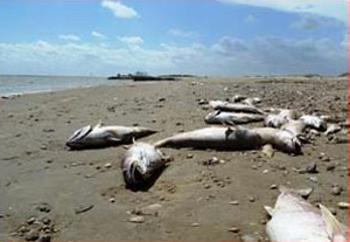
Thousands of Dead Fish Wash Up on Galveston Island

GALVESTON, Texas, August 13, 2012 (ENS) – Thousands of dead fish that washed ashore on Galveston Island over the weekend were killed by a toxic algal bloom, state officials confirmed Monday.
The Texas Department of State Health Services said a bloom of Karenia brevis, also known as red tide, was found in Galveston Bay in concentrations high enough to kill the fish.

Texas Parks and Wildlife Department officials began receiving reports of fish kills on Friday.
The reports were from Quintana Beach to the mouth of the Colorado River and included mostly Gulf menhaden, also called shad, with a few mentions of gafftopsail and hardhead catfish.


dead fish

Additional fish kills were reported over the weekend at Surfside Beach and Galveston; samples were collected from the Surfside jetty and San Luis Pass to look for Karenia brevis. 

In addition, fishermen reported coughing and dead fish 4 miles offshore of Galveston. Dead flounder and stingrays have been reported at Kemah and Bacliff.

Biologists originally thought that low oxygen levels were to blame, so additional investigations were conducted to determine if K. brevis was, in fact, the cause. 

On Sunday, the Texas Health Services biologists found varying levels of K. brevis in their sampling and officials then closed the following several areas of Galveston Bay to shellfish harvesting.
State officials are still investigating this event. Weather permitting, Texas Parks and Wildlife officials intend to conduct a coastal overflight later this week to get an aerial view of the bloom.
In Galveston, Parks Board Executive Director Kelly de Schaun told reporters crews worked overnight to clean the beaches most frequented by the public and the western end of the island, which had the largest concentrations of dead fish. 

A second, smaller wave of dead fish arrived Monday morning and was removed, she said. Crews must clean the entire 32 miles of island beachfront, which is likely to take until Wednesday, de Schaun said.
In 2011 a red tide  covered most of the Texas Gulf Coast and Galveston Bay, closing oyster beds to harvesting.

K. brevis produces a toxin that affects the central nervous system of fish so that they are paralyzed and cannot breathe. As a result, red tide blooms often result in dead fish washing up on Gulf beaches. Three common signs of a red tide bloom are discolored water, dead fish and breathing difficulty, according to state health officials.

Jack Ralph, former head of the Texas Parks and Wildlife Department’s Kills and Spills Team said it may not be necessary to cancel a trip to the Texas Gulf coast just because of a red tide.

“If it were my family heading to the coast, I would not cancel a vacation because of red tide. It’s an isolated, patchy phenomenon that does not blanket every stretch of beach. On any given day, there are generally miles of good beach and clean water for beach-goers and anglers to enjoy. However, we encourage all travelers to heed the advice of the Texas Department of State Health Services, get the current facts and draw their own conclusions, since different people have different comfort levels with these kinds of situations.”
It’s usually okay to eat fish, crabs and shrimp during a red tide bloom because the toxin is not absorbed into the fleshy tissues of these animals, says the Texas state health department which adds that people should never eat fish found sick or dead, whether or not they are caught during a red tide.
Sightings of dead fish or suspected red tide can be reported 24 hours a day to Texas Parks and Wildlife Department officials communication centers; call 512-389-4848 in Austin or 281-842-8100 in La Porte.

lunes, 20 de agosto de 2012

Can help save coral

Southampton, UK — Research from the University of Southampton and the National Oceanography Centre, Southampton has found that an imbalance of nutrients in reef waters can increase the bleaching susceptibility of reef corals.

Corals are made up of many polyps that jointly form a layer of living tissue covering the calcareous skeletons. They depend on single-celled algae called zooxanthellae, which live within the coral polyps.

The coral animal and the associated zooxanthellae depend on each other for survival in a symbiotic relationship, where the coral supplies the algae with nutrients and a place to live. In turn, the algae offer the coral some products of their photosynthesis, providing them with an important energy source.

High water temperatures can block photosynthetic reactions in the algal cells causing a build-up of toxic oxygen compounds, which threaten the coral and can result in a loss of the zooxanthellae.

Without the algae, corals appear white, a state which is often referred to as 'bleached'. Bleaching often leads to coral death and mass coral bleaching has had already devastating effects on coral reef ecosystems.

The study of University of Southampton, published in the latest issue of the journal Nature Climate Change, has found that nutrient enrichment of the water can increase the probability of corals to suffer from heat-induced bleaching.

Within the coral, the growth of zooxanthellae is restricted by the limited supply of nutrients. This allows the algae to transfer a substantial amount of their photosynthetically fixed carbon to the coral, which is crucial for the symbiotic relationship.

Algal growth becomes unbalanced when the availability of a specific nutrient decreases compared to the cellular demand, a condition called nutrient starvation.

Researchers from the University of Southampton based at the Coral Reef Laboratory in the National Oceanography Centre, Southampton, found that an increased supply of dissolved nitrogen compounds in combination with a restricted availability of phosphate results in phosphate starvation of the algae. This condition is associated with a reduction in photosynthetic efficiency and increases the susceptibility of corals to temperature and light-induced bleaching.

Dr Jörg Wiedenmann, Senior Lecturer of Biological Oceanography at the University of Southampton and Head of the Coral Reef Laboratory, who led the study, says: "Our findings suggest that the most severe impact on coral health might actually not arise from the over-enrichment with one group of nutrients, for example, nitrogen, but from the resulting relative depletion of other types such as phosphate that is caused by the increased demand of the growing zooxanthellae populations."

Dr Wiedenmann adds: "Our results have strong implications for coastal management. The findings suggest that a balanced reduction of the nutrient input in coastal waters could help to mitigate the effects of increasing seawater temperatures on coral reefs. However, such measures will be effective only for a short period of time, so it is important to stop the warming of the oceans, which will otherwise destroy most of the reefs in their present form in the near future.

"Finally, our results should help the design of functioning marine reserves.."

viernes, 13 de julio de 2012

Marine mammal specialists from across the country have descended on an Alaska aquarium

Seward, AK — Marine mammal specialists from across the country have descended on an Alaska aquarium to help care for a baby beluga whale that became separated from its mother shortly after its birth.

The male calf is under 24-hour care at the Alaska SeaLife Center in Seward, being fed by a stomach tube while learning how to suckle from a bottle.

"He's currently doing very well, swimming on his own and he has been from the first time he got here, learning to take food from a bottle, which has been challenging," said Tara Riemer Jones, the center's president and CEO.

It's believed to be the first baby beluga rescue in the United States, at least since federal record keeping began in 1972, she said. Other attempts at rescue resulted in calf deaths or in one case, the calf being returned to its pod.

It's such a rare event that specialists have been helping with the animal's care, including staff members from the Georgia Aquarium in Atlanta, Shedd Aquarium in Chicago and SeaWorld in San Diego.

"It's actually a pretty unprecedented event in certain ways," said Dennis Christen, the Georgia Aquarium's director of animal training who was in place 29 hours after the calf arrived in Seward.

The whale was estimated to be 2 days old when it was found near South Naknek, in Alaska's Bristol Bay, on June 18. Officials believe a storm likely separated the calf from its mother.

Tim Lebling, the Alaska SeaLife Center's stranding coordinator, flew to South Naknek that afternoon to retrieve the calf.

It was flown 90 minutes back to Seward in dry transport. Lebling said the calf was placed on an air mattress in the plane, placed so its weight wouldn't put pressure on vital organs and then constantly covered with wet towels.

Lebling said it was touch-and-go for the first part of the flight, probably because of stress.

"We thought he took his last breath at one point," Lebling said, but then he breathed again.

Even though the beluga is still in critical care, caregivers are guardedly optimistic about his rehabilitation.

Survival odds for an animal this age coming into a stranding program are low, said Brett Long, the husbandry director at the center.

"We take it a day at a time," he said. "We're very happy to see that we appear to be meeting its nutritional goals and that it's maintaining its weight, and we're seeing slow, incremental weight gain."

The calf is now about 5 feet long and weighs 115 pounds, up 5 pounds since his arrival.

The biggest worry now is the calf's immune system, which is insufficiently developed because it did not receive any of its mother's milk.

"We are working with other aquariums to provide supplements that will help aid the development of that immune system, but it's a waiting game," Long said.

Jones said there is nothing specifically wrong with the calf medically "other than he's young and at high-risk."

"We're not going to say it hasn't been without some bumps in the road," Christen said. "We're very confident we're on the right path here, but it's still an animal that's in critical care, and we have to be guarded in our optimism, and we're just hopeful we're on the right path."

At the center, the calf has its own pool with toys and constant human companionship. At least three caregivers are with him 24-hours a day, two of them in wet suits and in the pool.

He often will rub up against his human handlers, who also help him learn new swimming patterns and play with him.

He's being kept out of the public's view for now in a pool being fed warmer water and in a sanitary environment. The hope is to move him soon to a larger pool, which can be seen from behind glass inside the Alaska SeaLife Center.

It's running about $2,000 a day to care for the calf, and that's not including the cost of the visiting marine mammal specialists.

Jones said the cost will strain the private, nonprofit research center's stranding program budget for the year, and officials are talking to potential donors and possibly setting up a donation matching program for individuals. They're also planning a 5K Wildlife Rescue Run on Aug. 4, encouraging virtual runners to sign up online to raise funds.

If the calf survives, he'll never see the open ocean again since there is no way now for humans to teach him survival skills.

The National Marine Fisheries Service will eventually decide where he will be placed.

"There are a number of facilities that would make a great home for this young whale, with companion animals that would likely accept him into their kind of family unit," Christen said.

Since facilities that take in animals like to be part of the naming process, the Alaska SeaLife Center hasn't given the calf a name yet.

But that hasn't stopped most everyone caring for him from calling him "Naknek."

martes, 10 de julio de 2012

Finding scallops is like an Easter egg hunt

STEINHATCHEE - Finding scallops is like an Easter egg hunt, something that adults and children alike can do in the typically crystal-clear water of the Gulf of Mexico.

This year, Tropical Storm Debby dumped record rainfall on North Florida right before the July 1 start of the scallop season. As a result, the tannin-stained water of the region's rivers and creeks has been pushed far into the Gulf and has reduced visibility for the time being.

"You've just got to work a little harder for the Easter egg hunt this year," Charlie Norwood, owner of Sea Hag Marina, said this week.

Scallops were found in lower numbers than last year near Steinhatchee and other locations surveyed last month by the Florida Fish and Wildlife Commission. Boaters at Sea Hag Marina reported this week that scallops were abundant, but seeing them through the murky water was a challenge.

"It's tea-colored out there," said Greg Moody of Adel, Ga. Visibility, some scallopers said, improved at low tide.

The influx of fresh water also reduces salinity, which can stress and potentially kill scallops and other saltwater species. Tests done Tuesday by Norwood and Fred Vose, Florida Sea Grant marine agent for Taylor County, found that salinity was low near the mouths of waterways draining into the Gulf but at levels healthy for scallops at other locations.

The dark water is "more of a problem for divers than the scallops," Vose said.

For Norwood and other Steinhatchee business owners, scallop season is one of the most economically important times of the year for the tourism it draws.

State officials opened the season early for the past two years to ease the economic hardship caused by the BP oil spill in the Gulf. This year, the wildlife commission instead permanently extended the end of the season to Sept. 25 from Sept. 11.

Norwood said he sees the most business from families with children out of school at the start of the season, so the additional two weeks are little help to him.

"The only ones going at the end of the season are the die-hards," he said. "Economically, I don't think it does anything."

From a biological standpoint, Vose said it's better to add time at the end of the season than the beginning. Scallop limits are determined by volume, so getting smaller scallops early in the season means a greater number are taken. The daily limit is two gallons of scallops in the shell per person or 10 gallons per boat.

The numbers in the wildlife commission's survey suggest that the extended harvests of the past two years have had an impact, Vose said. Four of the five locations surveyed saw lower numbers than last year, with Steinhatchee dropping to an average of 28.2 from 136.1 scallops observed per 600 square meters.

"Increasing harvest is something that's done with caution usually, and that's not the case this time in my opinion," Vose said.

In addition to extending the season, wildlife commissioners also directed staff to look into the possibility of a commercial harvest of scallops. Florida closed the commercial harvest in 1994.

An average of 25 or more scallops per 600 square meters is seen as large enough to sustain a healthy population, said Sarah Stephenson, an assistant research scientist who manages the scallop survey for the commission's research institute. Four of the five survey locations, with the exception of St. Joseph Bay, had figures greater than 25.

The number of scallops in Steinhatchee usually remains high from year to year because the water flow of the Big Bend tends to keep them in that area, Stephenson said.

domingo, 8 de julio de 2012

A bid to take whale conservation to the UN General Assembly failed at the International Whaling Commission (IWC)

Panama City, PANAMA - A bid to take whale conservation to the UN General Assembly failed at the International Whaling Commission (IWC) after criticism from hunting nations.

The motion said many species are not covered by IWC rules, and criticised Japan's scientific whaling programmes.

The delegates' final act was to decide to hold meetings every two years.

Meanwhile, the Danish and Greenland governments will "reflect" on whaling options for Greenland's Inuit after the IWC denied a bid to raise quotas.

The options include setting quotas unilaterally without the IWC's explicit approval, or even withdrawing from the body. Either would be intensely controversial.

Nothing caused more controversy here, though, than South Korea's announcement that it was preparing to allow some of its fishermen to hunt whales under regulations permitting a catch for scientific research.

Japan has had such programmes in place since 1986, including an annual hunt in the Southern Ocean, which has been declared a whale sanctuary.

That was one focus of the resolution, tabled by Monaco, that called on the UN General Assembly to debate whale conversation.

Another was that whaling nations want the IWC's remit restricted to species that have been hunted, while others want it to work for the conservation of all cetaceans.

The resolution invited governments to "consider these issues in collaboration with the UN General Assembly, with a view to contributing to the conservation efforts of the IWC".

South Korean proposals for scientific whaling provoked protests by environmentalists There was general acceptance that such a resolution should only go forward by consensus, and it was soon clear that consensus was absent.

Norway's Einar Tallaksen said issues regarding cetaceans "are not a matter for the UN General Assembly, but for the competent fisheries organisations, including the IWC".

As far as this meeting is concerned, the proposal is abandoned, though Monaco will work for it within the UN and is launching a "task force" of supportive nations.

"Clearly the whaling countries want to contain any discussion of their whaling inside the IWC," commented Patrick Ramage, director of the global whale programme with the International Fund for Animal Welfare.

"They don't want their diplomats at the United Nations to have to defend the indefensible."

On the final day of the IWC's annual meeting, held this time in Panama City, delegations were also mulling the implications of Denmark's decision to leave without a whale-hunting quota for the Greenland Inuit.

They came to Panama asking for increased quotas for humpback and fin whales, in addition to maintaining existing levels for minkes and bowheads.

The bid became more controversial after environment groups reported finding whalemeat on sale in many supermarkets and restaurants, and, with the EU against the expansion, the bid failed.

"We are going to go home and reflect, because this is a situation that needs to be handled with care," said Danish delegation head Ole Samsing.

Experienced observers noted that in previous years, Denmark has been willing to compromise its requests in order to get something agreed.

The EU would have supported a continuation of the existing quotas, but the Danes opted instead to leave with nothing.

"There can be no doubt that Denmark knew when it put the proposal to a vote that it would fail," said Sue Fisher, on behalf of the Washington DC-based Animal Welfare Institute.

Continue reading the main story Guide to the great whales
BlueBowheadFinBryde'sRightHumpbackSeiGraySpermMinke"It could have walked out of here days ago with a perfectly adequate quota to meet the subsistence needs of indigenous communities in Greenland for the next six years, but it was prepared to lose everything for a handful of extra whales that, our recent surveys show, could well end up on the menu in tourist restaurants".

Japan's deputy commissioner, Akima Umezawa, said the vote against Greenland had been the most disappointing aspect of a discouraging meeting.

"Many pointed out the commercialism and the increased quota," he said.

"But commercialism is accepted by the definition of [aboriginal] subsistence whaling, and the increased quota was accepted and endorsed by the IWC scientific committee."

The issue is made more complex by the evolving relationship between Greenland, a hunting-based society of just over 50,000 people, and its former colonial ruler.

Several years ago, Greenland formally asked the Danish government to put its whaling outside the IWC's aegis, but it is understood that it would now prefer to remain within the organisation.

It is inconceivable that hunting will stop, so the question is how Greenland intends to go forward.

Its own interpretation of rules on aboriginal subsistence whaling (ASW) is that countries are entitled to set their own quotas, provided they are consistent with IWC scientific advice. Other countries disagree.

The US is also opening the door to unilateral action, with draft legislation introduced into Congress that would allow the government to set quotas if the IWC denied them.

Overall, many observers said this had been the most functional IWC meeting for years, with votes taken in an orderly fashion and a relative absence of grandstanding.

Six years ago, the pro- and anti-whaling camps were roughly equal in number.

Now, the anti-whalers clearly have the upper hand, and it was noticeable that many of the Caribbean delegations were down to a single person.

The decision to hold meetings every two years from now on is part of an ongoing process - largely driven by the UK and Australia - aimed at making the commission more functional and efficient.

Delegates concluded by selecting their first ever female chair, St Lucia's Jeannine Compton-Antoine
.